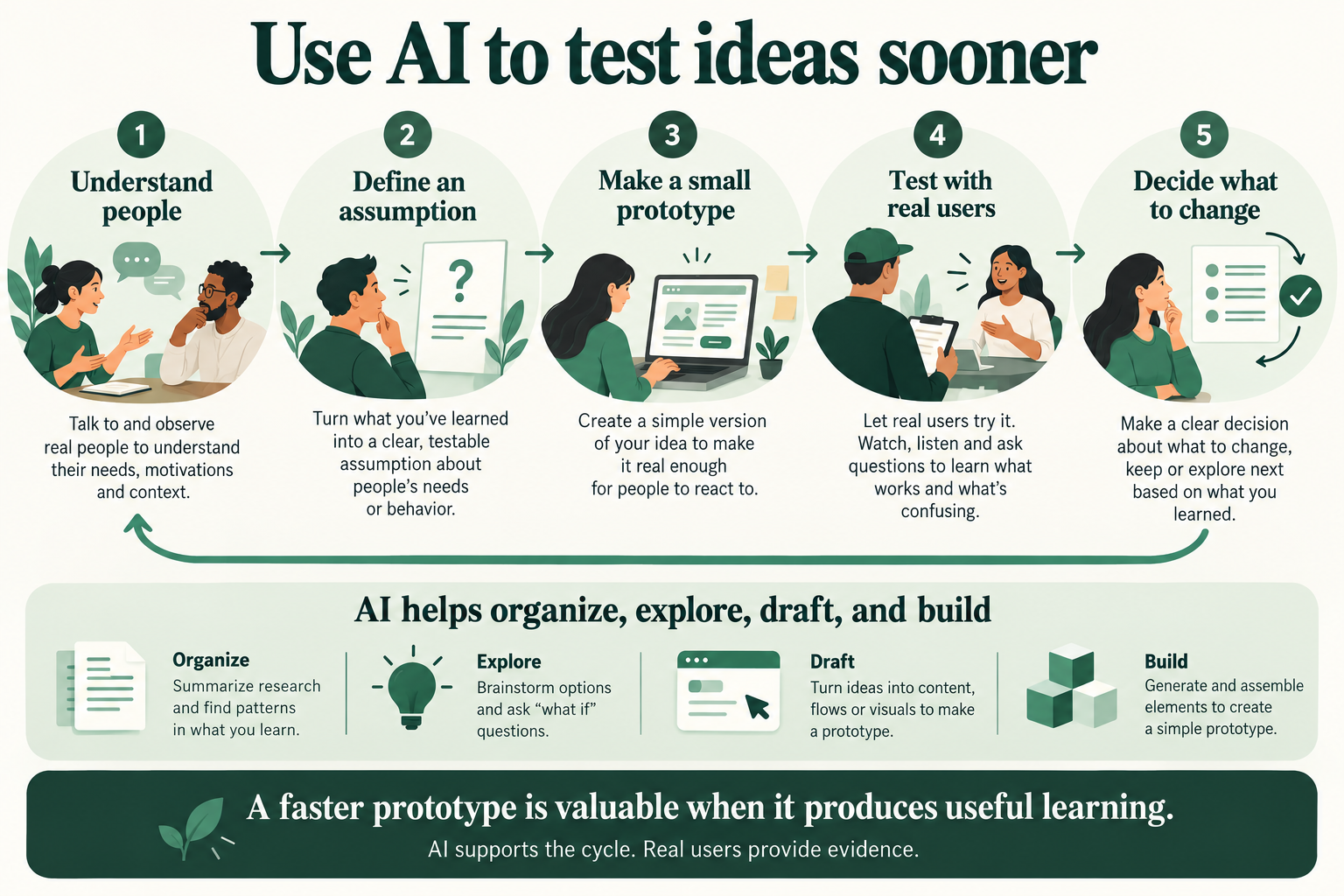
AI can make a first draft or prototype easier to produce. The product opportunity is to use that speed to learn sooner. A polished concept still needs evidence that it solves the right problem.
Start with people and a clear assumption
Design thinking keeps attention on the people using the product and the situation they face. Listen to their experience, define the problem, and identify the assumption that needs testing. AI can help organize notes and explore alternatives, while the team checks the interpretation against what people actually said.
Prototype the question you need to answer
Choose the smallest artifact that exposes the uncertainty: a storyboard, clickable flow, sample report, or limited working demo. AI can help draft interface text, generate alternative flows, or assist with implementation. Match the prototype to the question instead of building the whole product.
A small experiment card: pitch preparation
The following is a hypothetical test, using approved or synthetic prospect data. It is a limited learning exercise, not a customer deployment.
- Assumption: a salesperson can use an AI draft to recommend a pitch angle and justify it with the prospect facts provided.
- Task: prepare a short pitch for one realistic prospect and explain why each recommendation fits that prospect.
- Prototype: a simple page showing the prospect fact sheet, a draft pitch, and a source beside each important claim.
- Observation: watch which facts the salesperson checks, which recommendations they reject, and where they need outside help. Ask them to explain the reasoning, rather than rate the screen.
- Decision: if recommendations cannot be justified, improve the evidence links or narrow the task before testing again. If the reasoning holds with acceptable effort, test the next uncertainty with more representative users.
A positive reaction to the prototype does not establish willingness to pay. That requires a separate commercial test with a relevant buyer and a meaningful commitment. Simulated users can help prepare the session, but real user behaviour provides the evidence for this decision.
Keep the learning cycle short and the decision explicit. AI is useful here when it helps the team discover a weak assumption before investing in a fuller product.