A product team can have a clear vision and a busy backlog yet still struggle to explain how the two connect. We build features, complete tasks, and move through the roadmap. But activity alone does not tell us whether the product is moving in the right direction.
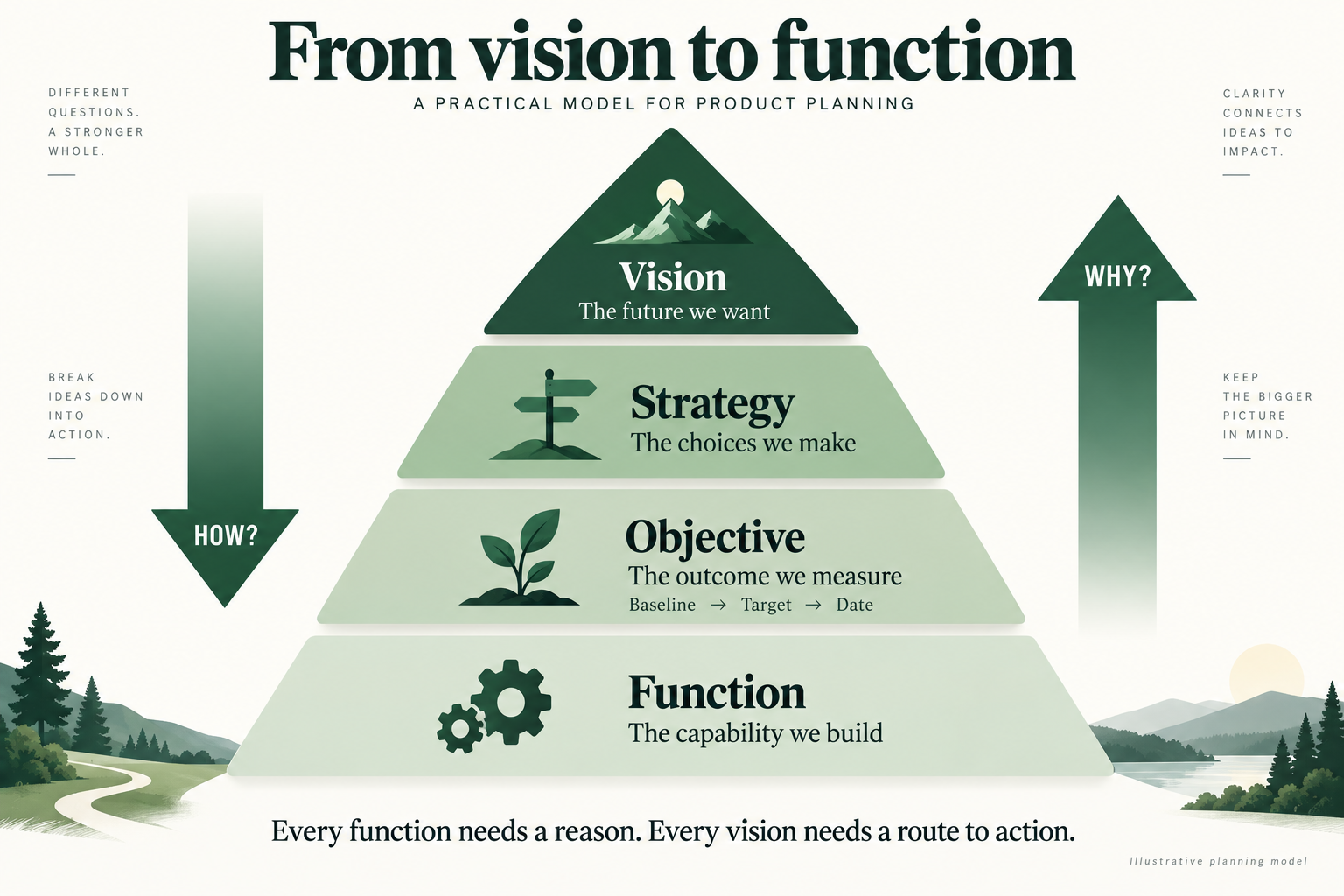
I find this sequence useful: Vision → Strategy → Objective → Function. Moving down explains how we intend to make progress. Moving up explains why a piece of work deserves attention. The connection matters more than the number of items in the backlog.
Vision: describe the future worth working towards
Vision gives the team a shared direction: where we are going, whom we serve, and why the product matters. It should describe the change we want to create for people, with enough clarity to guide decisions. A list of features cannot do that on its own.
Strategy: make choices about how to get there
Strategy explains where we will focus and how we expect to succeed. Which customers and problems will we prioritise? What advantage can we build on? What will we defer or avoid? The choices need to fit the market, our capabilities, and the resources available.
Objective: define progress we can observe
Objectives translate the strategy into outcomes the team can evaluate. Be specific about what should improve, how it will be measured, and when it will be reviewed. For a measurable objective, record a baseline, a target, and a date. Agree who owns the outcome and where the evidence will come from.
“Release a new onboarding flow” describes delivery. An outcome objective should define successful setup: for example, the user completes the first core task correctly and independently, with no unresolved setup error. Reaching the final screen alone does not establish success.
Function: choose what to build and test the contribution
Here, “function” means a product capability or feature. It is the part of the solution that people can use: a guided setup, a progress indicator, an integration, or another capability. Explain which objective it supports and why we expect it to help.
Treat that contribution as a hypothesis. A completed function is evidence of delivery; user behaviour and product performance show whether it helped. Several functions may support one objective, and one function may contribute to more than one outcome. Keep the main reason clear enough to prioritise.
A hypothetical chain, and two features to trace upward
- Vision: help small business owners handle routine administration with confidence.
- Strategy: focus on first-time users completing the core workflow independently.
- Objective: improve the share who reach successful setup from a measured baseline to an agreed target by the review date, without increasing related support demand. Define the cohort and observation window.
- Feature A: guided import with clear error recovery. It supports the objective if import failures prevent the first core task; test that contribution.
- Feature B: custom profile themes. With no evidence that appearance prevents successful setup, its connection to this objective is weak. Defer it or investigate the need before prioritising it.
Trace Feature A upward: recovery could enable the first task, which supports independent use and the vision of confidence. Trace Feature B upward: the proposed benefit needs evidence. The exercise explains why one feature deserves a test while the other needs a stronger reason.
Try it on the next backlog decision
Fill in this short template for two competing features. Leave a gap visible if you cannot yet explain the connection.
- Function: [proposed capability] helps [user] complete [task].
- Objective: it should improve [behavioural outcome], measured using [baseline, target, cohort, observation window, and review date].
- Strategy and vision: it supports [chosen focus] because [reason], contributing to [future we want to create].
- Evidence and decision: we believe this because [evidence]; [owner] will test [assumption] and continue, revise, or defer based on [signal].
Trace the reason upward and the plan downward
- For each proposed function, ask which objective it supports and what evidence would show progress.
- For each objective, explain the strategic choice it advances.
- For the strategy, show how the choices support the vision.
- From the vision, check that the team has a credible route to action and review.
A missing connection is a signal to investigate possible scope creep. It is not automatic proof that the work is unnecessary. Reliability, security, compliance, and maintenance can enable the product’s goals even when their value is less visible. Make that rationale explicit instead of forcing every task into a growth metric.
Give each feature a reason that can be tested. The chain is useful when it changes a priority or exposes a missing assumption, rather than becoming another document to maintain.