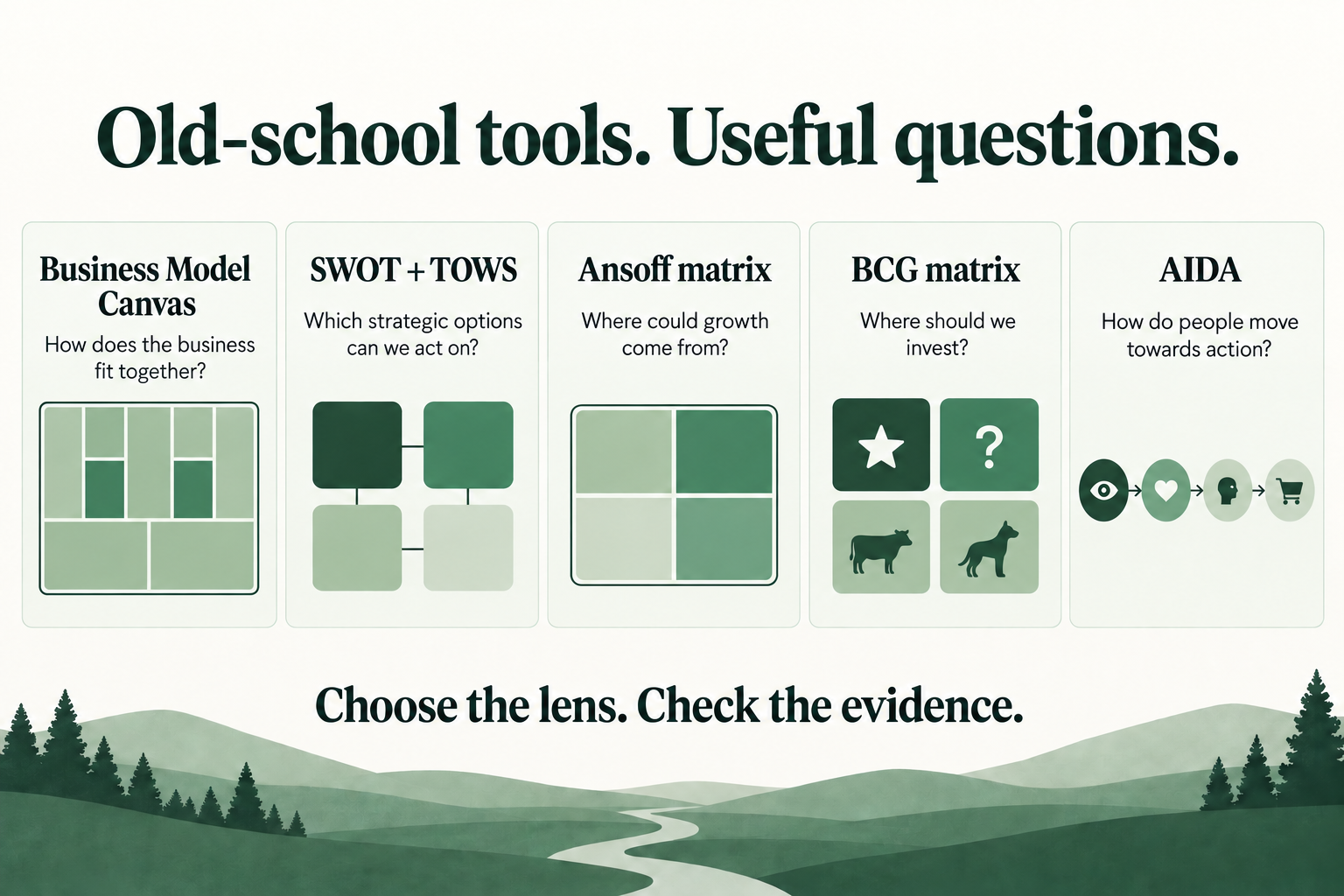
New tools can make research and planning faster, but I still find value in familiar business frameworks. Their usefulness comes from the questions they help us ask. A simple canvas or matrix can expose a missing assumption, a dependency, or an option that the team has overlooked.
Choose the question before the framework
- Does the business model fit together? Use the Business Model Canvas.
- How should we respond to our situation? Use SWOT to diagnose it and TOWS to explore strategic responses.
- Where could growth come from? Use Ansoff to compare product and market choices.
- Where should portfolio resources go? Use BCG as a starting lens, then examine economics and dependencies.
- How does our communication lead to action? Use AIDA.
Business Model Canvas: check model coherence
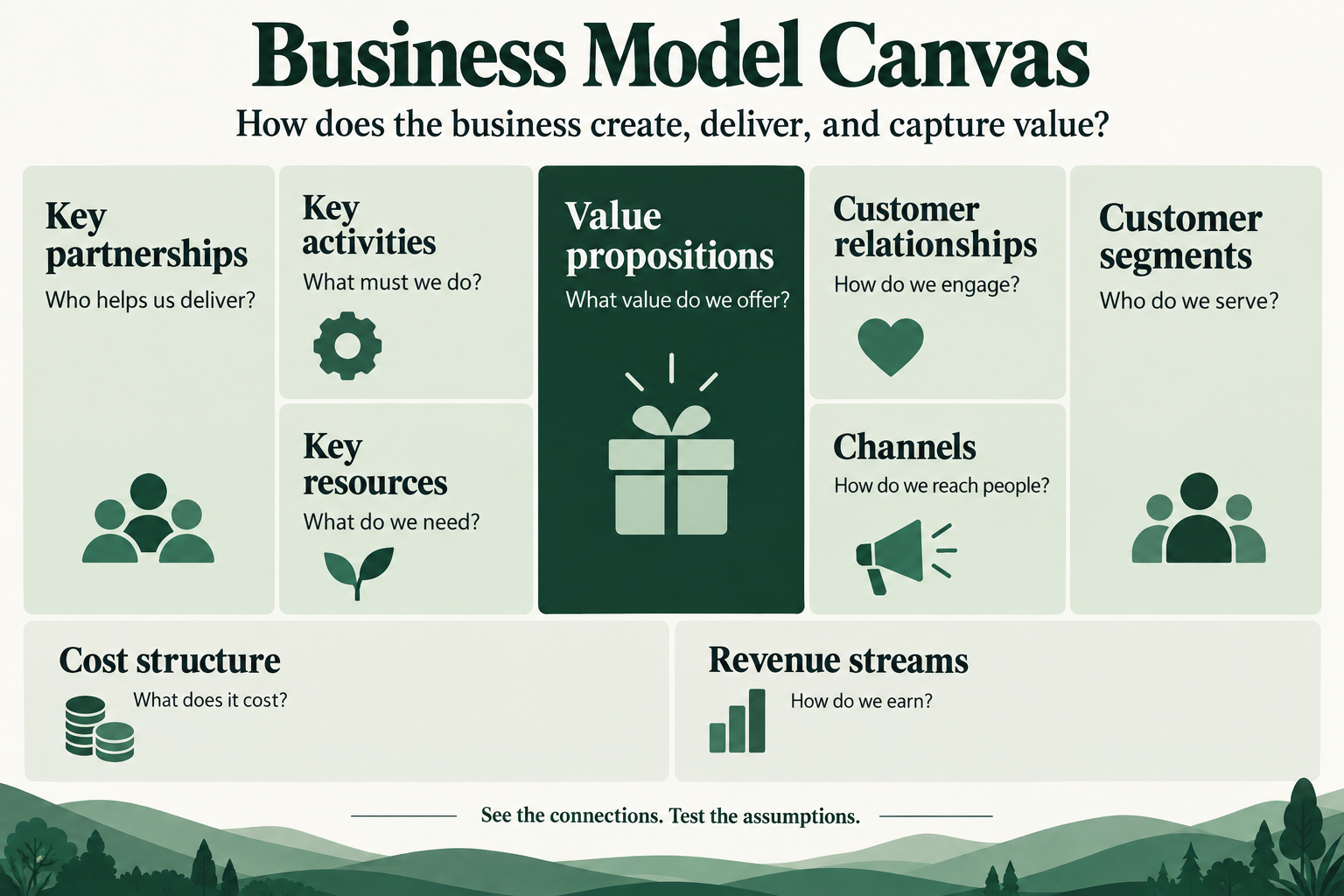
Its nine blocks connect customers and value with channels, relationships, revenue, resources, activities, partners, and costs. Check whether the promise to customers has an operating model behind it. Use a separate process map for detailed operational steps.
SWOT and TOWS: move from factors to responses
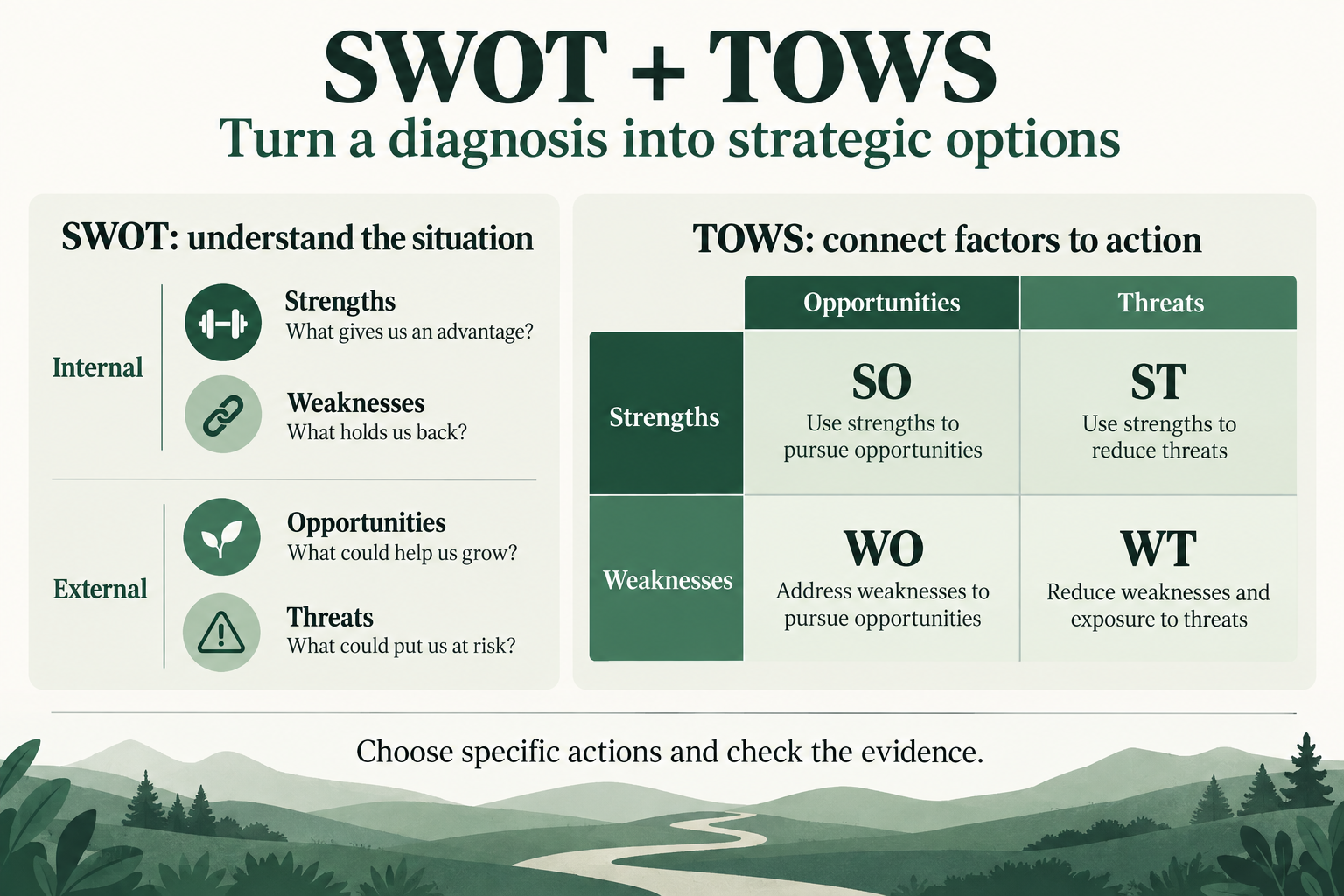
SWOT separates internal strengths and weaknesses from external opportunities and threats. TOWS connects them to possible actions. Name the capability, constraint, or market evidence behind each factor so the exercise produces choices rather than generic labels.
Ansoff: compare growth directions
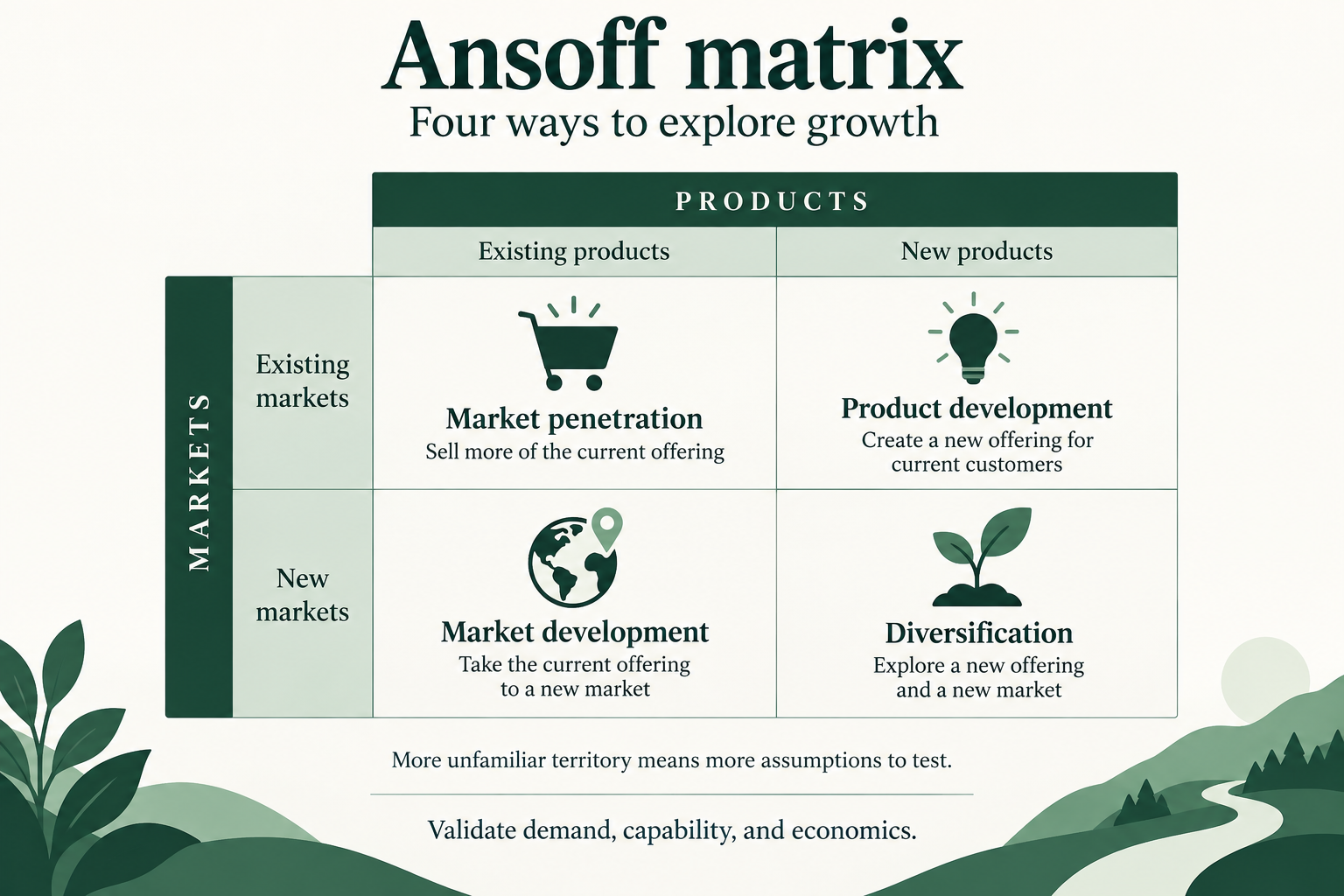
Existing or new products crossed with existing or new markets give four routes: market penetration, market development, product development, and diversification. Each route needs evidence of demand, capability, and economics; the matrix itself is not a business case.
BCG: question portfolio investment
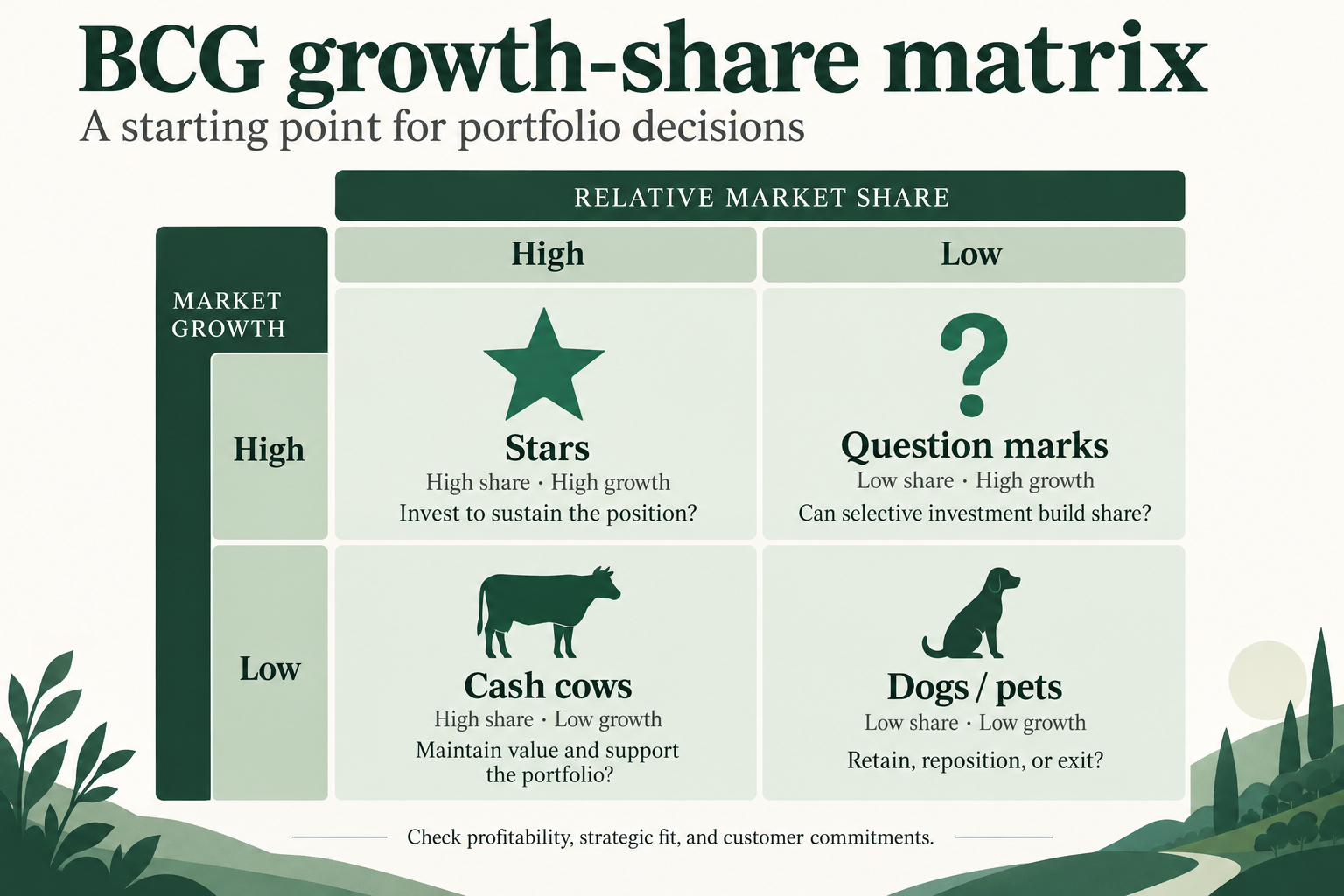
Market growth and relative market share organise the discussion into stars, cash cows, question marks, and dogs or pets. Treat these as prompts to investigate. Profitability, customer commitments, strategic fit, and dependencies matter before choosing investment or exit.
AIDA: examine communication and action
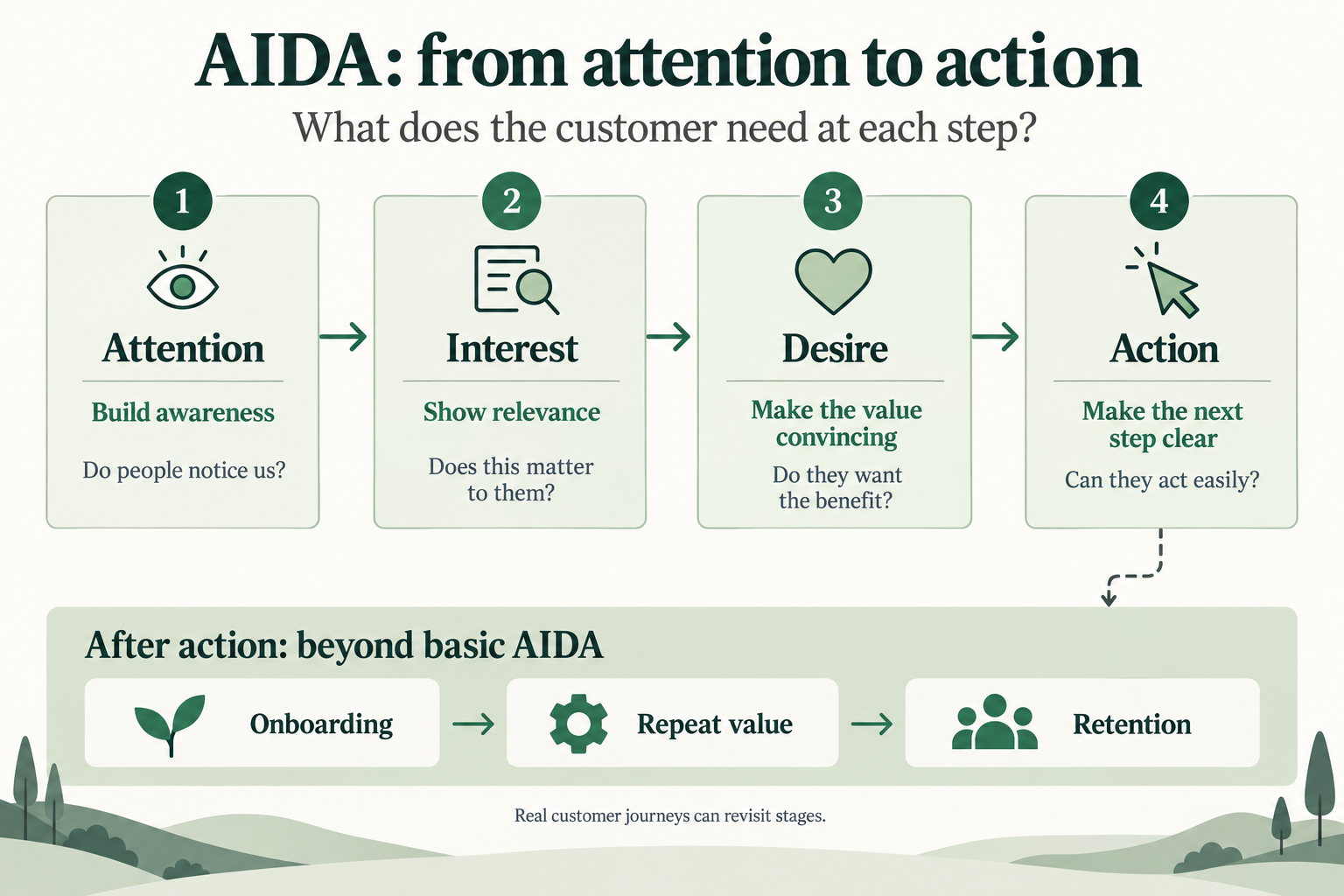
Attention, Interest, Desire, and Action help examine whether a message is visible, relevant, convincing, and easy to act on. Onboarding, repeat value, and retention need attention after action; customers do not always follow a tidy sequence.
A hypothetical decision: keep, reshape, or close a product?
Imagine a low-share reporting add-on in a slow-growth market. BCG raises an investment question, but account reviews suggest the add-on helps customers use the wider service. Closing it could weaken that offering. The matrix alone cannot establish that closure creates value.
Use the Canvas to trace who relies on the add-on, its revenue contribution, and its support cost. Check usage and customer commitments before deciding. In this scenario, the next step is to test whether a simpler supported version preserves that wider value at acceptable cost, then compare it with closure. A framework has improved the question; evidence still has to determine the answer.